Some artists find you. Some you have to seek out. Others, you admire from a distance.
I met Billy and several other Adore Recordings artists one night through a random invite from a friend’s brother to the “4-Track Club.” The 4-Track Club was a monthly gathering of musicians who came together to share the music they were each working on. The group included many of Cincinnati’s top bands and musicians. It was there that I first heard several projects and bands that Billy was involved with, including the band Ruby Vileos.
What struck me first wasn’t a genre. It was a feeling. A temperature. Billy also makes music under the name EUXINE, and the experience of listening to it is more like stepping outside on a cool, quiet morning than anything I’d call a “track.” That’s no accident. It’s the result of a lifetime of listening, failing, discovering, and refusing to stop asking what sound can actually do to a person.
As a young record label owner, being in that space monthly with Billy and many other talented artists set the standard for every artist I signed to Adore Recordings. I dreamed from that first night, meeting Billy and others, of one day releasing music from 4-Track Club artists. It took me over 20 years to approach Billy to see if he would be interested in releasing music on Adore Recordings. That dream manifested, and finally, we are here.
This is his story, in his own words, with very little getting in the way.
Roots: Kansas City, Cincinnati, and a Guitar Nobody Knew How to Play
Billy was born in Kansas City, Missouri, and moved to Cincinnati, Ohio, at a young age. That’s where music found him, or more precisely, where he discovered sound before he ever discovered music.
There was no formal training. No lessons. Just curiosity and access to things he probably wasn’t supposed to touch.
“I began experimenting with my older sister’s acoustic guitar. Before learning chords or anything, I used it just to make noises. I discovered a microphone plugged into a cassette player on record/pause would amplify the mic input. I remember using the mic to tap and scrape strings, make feedback, and dropping it into the guitar body and using the guitar like a drum.”
Then came the electric guitar, a makeshift cable his dad helped him build, and an old tube turntable repurposed as an amplifier.
“I still didn’t know chords or anything, but I had real amazing moments just beating on the guitar and making feedback before the tubes caught fire. I just fell in love with the sound of feedback and distortion.”
That instinct, chasing feeling over technique, never left him. It just kept taking new forms.
The Education: Punk, Hardcore, and the Slow Turn Toward Melody
By his early teens, Billy had found his people. His older sister had good taste, and through her, he discovered The Raincoats, PiL, Velvet Underground, and Bowie before he turned 14. That experience led him directly into punk and hardcore.
“Most of my music then reflected that. My first bands were influenced by Bad Brains and Husker Du. Despite all the noise, I did always have an affinity for melody and the bittersweet side of emotion.”
But something was shifting beneath the noise. Between 15 and 17, the harder edges began to soften, not because the intensity left him, but because a different kind of intensity started pulling harder.
“There was a distinct shift where more melodic interest replaced the typical hardcore stuff. Husker Du, Meat Puppets, Replacements, Soul Asylum, as well as bands that were evolving musically out of typical hardcore like Government Issue, Rites of Spring, Dag Nasty, Bad Brains, were all things I was trying to emulate in certain ways.”
The moment was sparked by a single song: Husker Du’s cover of ‘Eight Miles High’ by The Byrds.
“There was a revelation there where all the noise and raw passion of punk connected with melody and emotional depth. I think that song in particular helped because, of course, I grew up hearing all that classic rock stuff and loved it in a visceral way, but I was still too young to fully understand it. That cover reconnected me to everything I internalized as a child, but added everything I was learning as a teen. It was an exact moment hearing it that led me on a path away from what I’ll call the ‘macho’ side of music and more toward an emotional one.”
The Moment That Changed Everything
Every artist has a moment that shifts their perspective. For Billy, it didn’t occur in a studio or during a show. It took place alone, in a park, on an ordinary weekday afternoon.
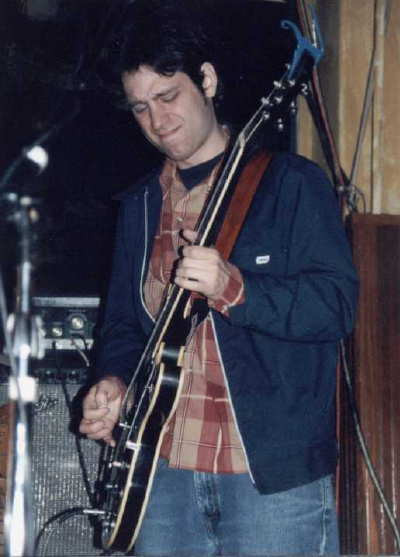
“I was maybe 19 or 20, and in the middle of the day on a weekday, I walked alone to a park. There was no one around, and it was a cool but sunny day, and I was having a perfect, almost meditative moment, just enjoying the silence and the simple sounds of birds, wind, and leaves hissing, when someone who could’ve been as far as half a mile away started playing bagpipes. Something about the distance and the clarity and the way the sound traveled with the wind and blended with the natural sounds. It was just beautiful. I still try to find and create sounds that take me to that moment. It was almost transcendent, as cliché as that sounds. It was as peaceful and inspired as I can ever remember feeling, and it was because of sound.”
I want to pause and think about that for a moment. Not because it’s poetic, although it is, but because of what he took from it.
“If I realized anything about myself in that moment, it was that real tranquility and inspiration can exist, and it was really only sound that was going to take me there.”
The experience didn’t immediately lead to a new album or technique. Instead, it opened up a broader horizon of what he was willing to accept.
“It was definitely a time in my life when I was opening up and getting a deeper understanding of music outside the vocal-oriented rock world. I was starting to really appreciate everything from 70s dub, Indian classical, and free jazz. Coltrane, Shakti, Michael Hedges, Keith Jarrett.”
Looking back, Billy understands exactly what that afternoon unlocked.
“I think it was significant because it helped unlock openness, formlessness, and general abstraction as a gateway to different kinds of beauty. Even though a lot of my work still conforms to traditional structure, I hold those feelings and challenge myself by finding them even within more confined forms. I consider myself a songwriter above any other label, but when I’m listening to music, I tend to mostly enjoy wordless, abstract, and free-form sounds. There’s an endless quest built into all of it that I think fuels me.”
What EUXINE Actually Sounds Like
Genre labels don’t mean much here. When I asked Billy to describe how his music makes him feel, not the genre, his answer was more honest than most artist statements I’ve ever read.
“Connecting with emotion is at the root of anything I try to do. I hardly ever experiment for experiment’s sake or throw random words together just to see how they sound. What I aim for is the feeling of timelessness, being frozen in time, being directly transported to some type of feeling or memory. I fantasize a lot about a world where the sounds of machines are gone, cars are gone, the hum of massive HVAC systems on top of ugly buildings are gone, worrying about the future is gone, and the present and past are enough. That all sounds pretentious maybe, but that’s what I want to feel when I hear music, so that’s what I hope someone can feel in mine.”
The Process: Late Nights, Borrowed Guitars, and the Gift of Someone Running Late
Billy doesn’t romanticize his creative process. He describes it with the same straightforwardness he uses for everything else.
“I don’t really have a creative process. At this point, I work mostly from my home studio. Song and lyric-driven writing tends to happen in the small hours. I get pretty easily distracted by domestic things and background noise, so my porch late at night or early in the morning is where writing might happen.”
Then there’s this, which is one of my favorite things any artist has ever told me about where ideas actually come from.
“One of my favorite times is when I’m supposed to meet someone or go somewhere, and I’m regretting it, so those few precious minutes where someone is late, or my partner can’t find the keys, are almost always good for a flash of inspiration.”
He also values displacement. The cabin. The unfamiliar guitar.
“Sometimes just being anywhere but home, or playing any guitar that isn’t mine, is some kind of inspiration.”
When the work shifts into more abstract or experimental territory, the approach changes.
“I’ll start with a keyboard or drum machine. In those cases, there’s usually a mood or sound I’m after, and I build sounds until I find it.”
And underneath all of it, three things drive every session.
“The first being the general sense of peace and purpose I get from the act itself. Music is my boat, my golf course, my gym. It’s where I’m happiest and can lose myself. The second is some kind of emotion or feeling. It can be as exact as a lyric idea or as abstract as a strange sound, but there has to be a feeling there. The third is to try and outdo everything I’ve done before. I still have the bad habit of comparing myself to others, so I have this internal challenge to try and do things I think are as good as the things I love.”
What does he hope a listener walks away with?
“All I can hope is that they feel something emotional. Getting the weirdest synth sound, the perfect guitar tone, or the fattest kick drum isn’t something I think about or would want anyone else to. Unlocking a memory or feeling you’d forgotten, connecting with a strong feeling, being lost in nostalgia, or a sense of timelessness. Any vivid emotional response is what I’m after. I attack it from a lot of angles, sometimes with words, sometimes with melody, sometimes with raw sound, but that’s what I hope someone might experience.”
“I Dreamed I Couldn’t Sleep”
For EUXINE, Billy gives himself something he doesn’t always allow in his other projects: complete and total freedom. No intention to perform it. No pressure to recreate it. Each piece is treated like a canvas.
“I treat each piece more like a painting than a song. I brush and add color until I think it’s done, then never touch it again. In that sense, some of this material is as pure as I can offer.”
The EUXINE release on Adore, “I Dreamed I Couldn’t Sleep,” was born across two different home studios and a significant period of personal change. That context lives inside the music, whether you know it or not.
Billy describes the opening three tracks with the kind of precision that only comes from knowing exactly what you were reaching for.
“The end of Nada is directly inspired by that day at the park, hearing the bagpipes. There’s a bittersweet serenity there, a feeling of being toward the end, but it’s okay. A kind of abandon to the fleeting nature of the world. Blades of Kings is about having a deep and real appreciation for the good things in your life that forged you. And Sleigh Birds is about indulging in the dream worlds and strange archetypes that hang around in your subconscious and letting them come to life.”
Why Adore. Why Now.
When I asked Billy what it meant to be part of Adore Recordings, his answer reflected something I’ve believed since I founded this label in 1997.
“Connecting with Adore was so great because I know the inherent philosophy is so much more environmentally focused than any other label I’ve talked with or read about. There’s a whole new model emerging to find new ways to create and connect with people sonically. I think the music world in general needs this and will need more in the future, but for my work as EUXINE I hope we can create these new models together and be able to find ways to get interesting music out there without relying on all the old tropes in the music business that have sometimes hindered creative drive and left artists and labels feeling stuck in one basic mode on repeat.”
That is exactly the conversation I want to be having. That is exactly the kind of artist Adore was built for.
What’s Next
Billy is currently finishing the eighth full-length album by his band The Hiders, due for release in early summer 2026. After that, new material for his project, Ruby Vileos. And somewhere in between, EUXINE continues to evolve.
His two most recent releases under the EUXINE name give a clear sense of how far he’s willing to roam. “Second Hand Sorrow” was a concept album built entirely from lyrics pulled out of his high school punk journals, reimagined with new music and recorded as quickly and roughly as possible. A kind of excavation. Then came “Wander the Estate,” a collection that moves from trippy blues to meditative instrumentals, a record that refuses to hold still.
The search, as Billy would say, is endless. That’s the point.
At Adore Recordings, we’ve spent almost 30 years making space for artists who treat sound as a practice rather than a product. Billy Alletzhauser is exactly that kind of artist.